
Shopping centres are pursuing different futures. We mapped five ways they are diversifying
What a representative sample of 100 UK shopping centres shows about how they are diversifying, and what it means for the people who run them.
October 2026
Bidvest Noonan supports more than 50 shopping centres and retail parks across the UK and Ireland. This paper draws on a representative sample of 100 centres and on that day-to-day experience.
Summary
A woman walks into a shopping centre for an MRI scan. Where she is standing, people used to try on shoes. A few doors down the shops are still open, and shoppers pass the clinic without a glance. She did not come to shop, and she is now one of the reasons the centre is still here. That is a story becoming more familiar in centres across the UK.
Somewhere else a jobseeker is at a coaching session in a unit that used to sell clothes, or a member is in the gym before the shops open. None of them came to shop. In the most striking cases, the anchor tenant is no longer a department store. It is the NHS or the council.
That is the sharp end of the change, not the norm. Retail anchors all 100 centres, but beyond that they diverge: some take on leisure, some public services, some workspace or homes, and many add nothing at all. Each new use asks something different of the people and systems that keep the centre running.
The centre director’s role is broadening from running a shopping destination to managing a place with many uses, and the operation has to change with it. What matters is how: reading where a centre is heading and arranging the operation to match is what separates a service that keeps the basics running from one that adds value, in fewer incidents, steadier costs and a better experience.
This paper draws on a representative sample of 100 centres across different sizes and regions. The five areas of diversification describe what a centre has added to its retail core, which is what shapes how it has to be run.
- Deep diversification is rare. half the sample has food and drink but none of the other commercial uses, and only 18 have four or more.
- Diversification is uneven. Beyond the retail core, centres diversify across five areas: entertainment, fitness, public services, work, and living and staying. Over half have taken on at least one, but 44 have none, most of the rest have just one, and only one has more than three.
- Empty space is being reused. Former department stores and upper floors are becoming leisure venues, services and homes.
- Redevelopment often brings housing. 15 centres have a major scheme announced, 8 of them bringing in homes, and these are mostly the centres that are still mainly retail and food.
We see this change across the centres we support in the UK and Ireland, and, as part of the Bidvest group, in markets from Australia to South Africa to North America. The move towards something closer to a town centre is a global direction of travel, not a local quirk. For owners and directors, the opportunity is to give people more reasons to visit while strengthening the centre’s place in the life of the local town, and to make sure the operation can deliver on that promise day after day.
The question for every centre is the same: what kind of place are we becoming, and does the way we run it fit?
Finding 1: beyond shops and food, diversification thins out fast
Every centre in the sample has retail and food and drink. Because the sample was random, that core is genuinely universal, not a result of how we picked the centres. Beyond it, every use appears in fewer than half the sample: other leisure in 33, cinema in 32 and fitness in 26. No civic or social use appears in more than 8.
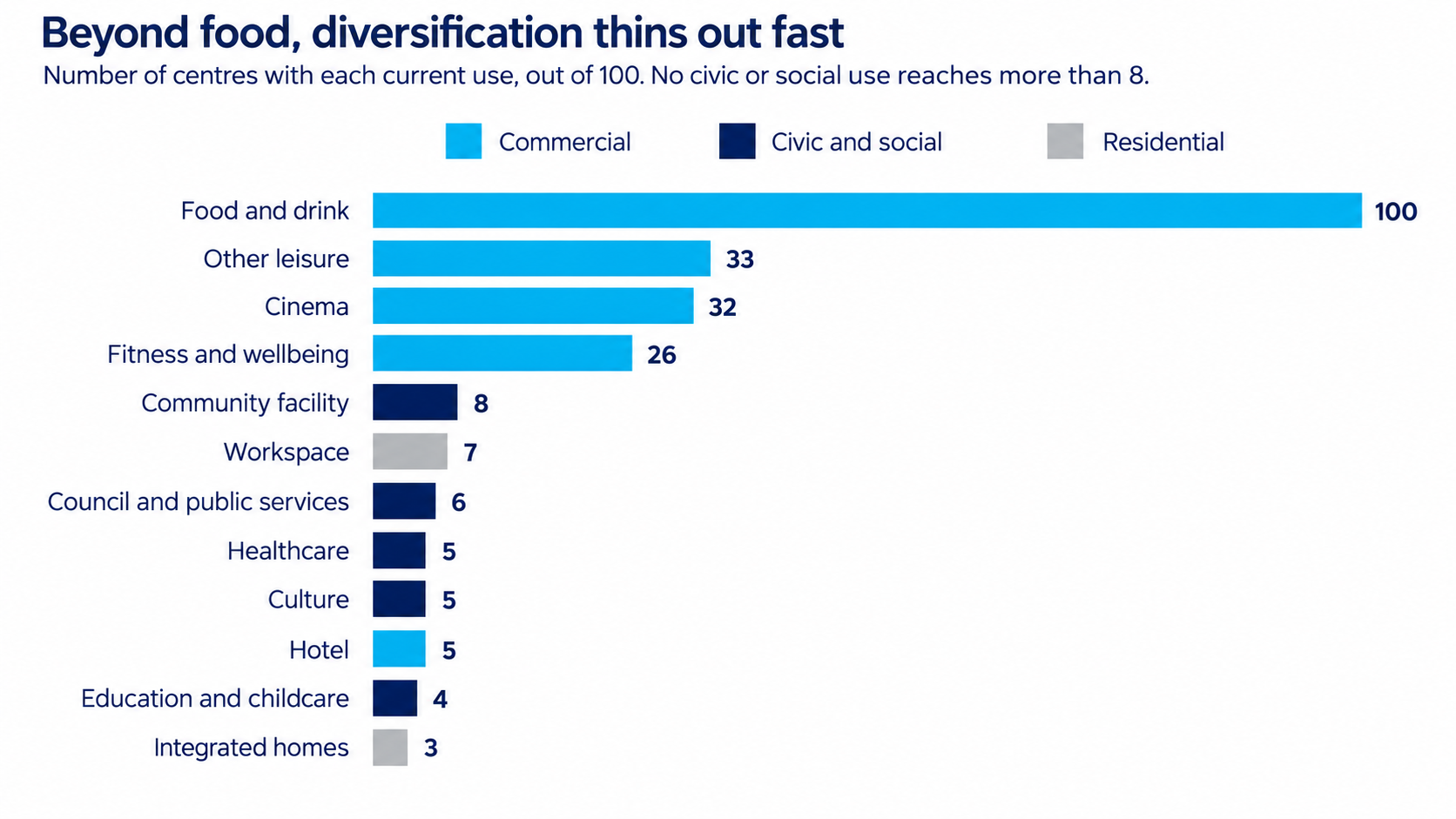
Current uses across the representative sample · counts out of 100
Ask what share of centres have taken on a civic or community use, a GP surgery, a library, a council desk, and most people guess high. In the sample it is 14%. The great majority, 86%, have none at all, and only 9% have more than one. Commercial depth is thin too: 49% have food and drink but none of the other commercial uses, and only 18% offer four or more. Most have diversified a little; few have diversified widely.
Finding 2: a shared retail core, with diversification across five broad areas
Strip a centre back and all share the same core: shops, food and drink, and everyday services such as banks and hairdressers. What differs is the mix of uses beyond that core. We found five broad areas of diversification: entertainment and leisure; fitness and wellbeing; public and community services; work and enterprise; and living and staying. A centre can combine any of them, and many combine more than one: 44 have none, 28 have one, and only one has more than three. Centres are not all following the same path, and each area brings different visitors, a different rhythm and often a different feel.
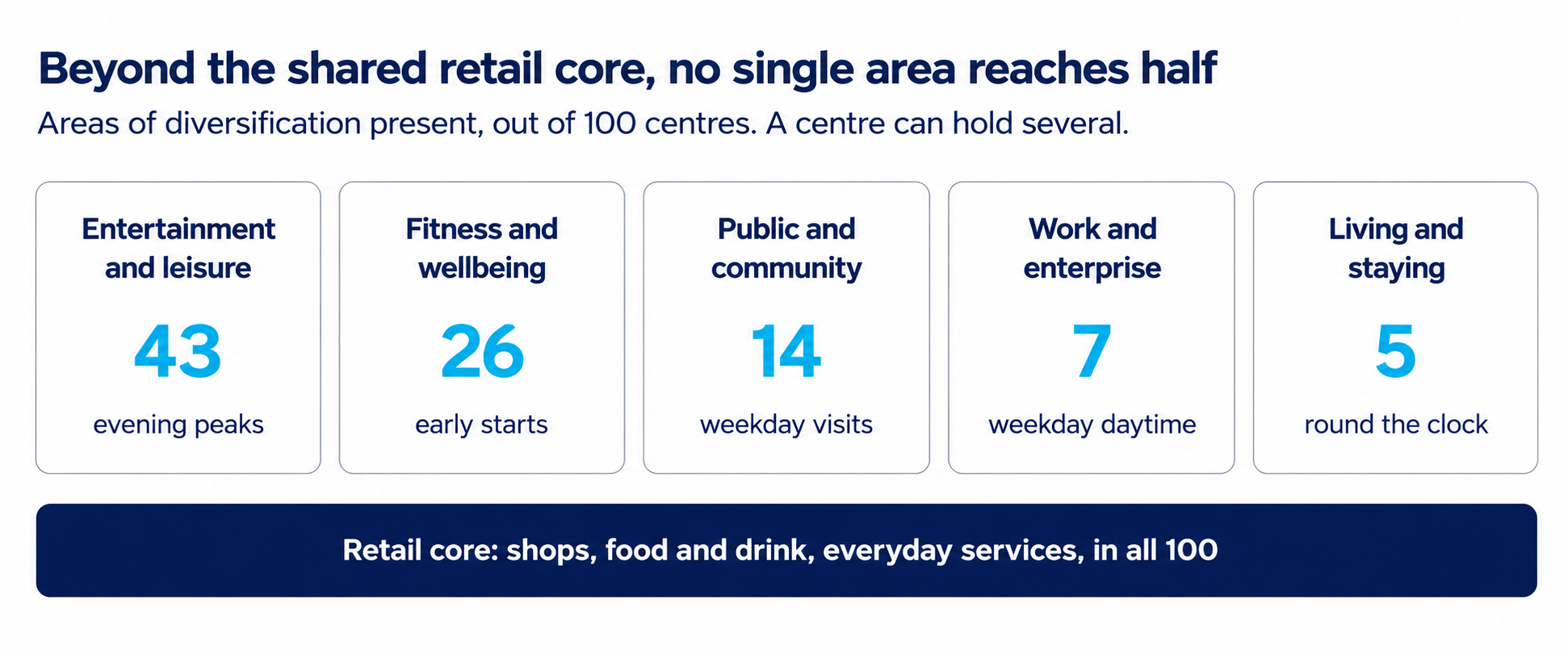
Entertainment and leisure is the most common area of diversification, in 43 centres: cinemas, bowling, climbing and the like. Fitness and wellbeing is in 26, usually a gym that opens before the shops.
Public and community services reach 14 centres, though only 9 have more than one. Cwmbran Centre combines health, council services, community provision and culture; Crystal Peaks in Sheffield has GP and dental care, a library and ShopMobility; and centre:mk in Milton Keynes runs a Citizens Advice employability service.
Work and living remain the least common areas of diversification today. Workspace and co-working appear in 7 centres, and homes or hotels in just 5. But living is where the pipeline is heading: 8 of the 15 announced redevelopments include housing. These are the uses that turn a centre into a neighbourhood rather than a destination.

Finding 3: empty space is being reused in many ways
Some of the most visible changes come from reusing empty space, often upper floors or former department stores, for something other than more shops. What goes in varies widely, from cinemas and gyms to clinics, libraries, offices and homes.
A few things recur. The space reused is usually a large single void, a former department store or a block of upper floors, which makes conversion viable. The new occupiers are a mix of commercial operators and public or community bodies. And the new uses tend to bring visitors with a purpose, an appointment, a class, a show, rather than browsers.
These uses are not just alternative occupiers. They change who visits, why and when, and what those visitors need from the building.
Finding 4: some centres are being redeveloped, several for housing
In the sample, 15 centres have a major redevelopment announced, and 8 of them bring in homes, against just 3 with housing today. These are mostly centres that are still mainly retail and food, rather than those that have already diversified. They are announced schemes rather than completed ones, but the pattern is consistent: where a mainly retail centre is being rebuilt, housing is often part of the plan.
What this means for the operation
An operation built for a retail mall will not, by itself, run a place people come to for their health, their work and their evenings out. Different uses place very different demands on the operation. Size is a poor guide too: the number of listed stores barely tracks how diversified a centre is. The table shows what each use asks of the operation.
| Area | Operating day | What changes for the operation |
|---|---|---|
| Fitness and wellbeing | Early mornings, long days | A different visitor at a different hour; new footfall and traffic in car parks, lifts and entrances before and after retail hours |
| Entertainment and leisure | Evening and weekend peaks | Crowds and queues in the common parts, later cleaning and security, more waste at night |
| Public and community services | Weekday daytime | Different visitors, some vulnerable; wayfinding, safeguarding and sometimes other languages in the shared areas |
| Work and enterprise | Weekday daytime | Steady weekday worker footfall, and access and passes to manage in shared areas |
| Living and staying | Round the clock | People in the building out of hours; overnight security, out-of-hours access and shared-area cleaning |
Few of these shifts are dramatic on their own; together they change the cost and rhythm of running the place. This is where an experienced FM partner earns its keep, giving a director an earlier, clearer read on what a new use will cost to serve, and on the different pressures and visitors it brings, rather than learning it after the doors open.
More uses, more peaks
Demand no longer arrives on a retail timetable. A gym opening before the shops needs shared entrances, washrooms and lifts ready earlier. A late restaurant extends cleaning and security into the evening. A flu vaccination drive, a health screening, a job fair or an evening event each brings its own surge. They arrive in waves: a rush of patients, then families, then a late crowd. A clinic and a shop can share a floor but cost very different amounts to serve.
Two pressures bear down at the same time. Expectations are rising: people who get a slick experience everywhere else expect one from their local centre. And costs keep climbing, with energy and labour dearer and good people harder to find and keep. This is where a specialist FM partner earns its place: absorbing the extra demand, covering the longer hours efficiently, and bringing the technology to do it.
Security becomes about reading a mixed crowd
A broader mix is felt first by the security team, and the job is no longer mainly deterrence. It is knowing who is coming and when, and that a patient, a shopper, a late-night diner and a jobseeker each need a different response. Approachability becomes a core skill, and at a community or employability use it can mean communicating across languages. Longer, more varied hours stretch the day, which tends to push teams towards technology to cover it efficiently: more use of CCTV, body-worn cameras (increasingly with live translation) and, on some sites, patrol robots after hours. And where a new leisure or event use changes the risk profile, a centre can come into scope for protective-security duties, such as Martyn’s Law, where it was not before.
Accessibility for every visitor
The centre now has to work for people with different mobility, sensory and communication needs, often in spaces that sit close together but call for opposite things, such as a lively entertainment zone beside a quiet waiting area. Training in hidden disabilities, autism and dementia awareness helps colleagues offer the right support, while the timing and method of cleaning and maintenance protect the atmosphere each space is meant to have. Measures such as Dementia Friends training, the JAM Card scheme and a quiet hour show how staff awareness and the way a space is managed work together.
Cleaning follows the new rhythm
Cleaning moves with the hours and the uses. Evening leisure pushes the heavy work later and adds food waste; early gyms pull some of it forward. Around a clinic or a community use the task is not inside the unit, which is the tenant’s, but in the shared parts: keeping routes, washrooms and waiting areas clean for people who may be there for an appointment rather than a browse, and taking more care through flu season. The pattern becomes harder to run as a single daily round. Automation helps absorb it: robotic scrubbers take the repeatable work and sensor alerts flag spills and shortages between rounds, freeing people for the detail and the busy periods.
Conclusion
Shopping centres are not simply adding new occupiers; they are developing different purposes. Some are deepening leisure and hospitality, some are taking in health, council and community services, and some are heading towards workspace or homes. Nearly half are still mainly retail and food, and in this sample that is where redevelopment is most often announced.
Whatever a centre becomes, the operation has to be built for that place, not for the retail mall it used to be.
The commercial opportunity for FM providers is not simply to supply more hours. It is to help the director design, set up and keep adapting how the place is run.
The question is no longer “how many cleaning, security and maintenance hours do we need?” It is “what kind of place is this, and what does it take to make it work?”
About Bidvest Noonan
Bidvest Noonan supports more than 50 shopping centres and retail parks across the UK and Ireland, providing cleaning, security, technical, facilities and reception services. That day-to-day experience, across the full range of the uses described here, informs the view in this paper.
As part of Bidvest Group, a dedicated UK and Ireland business can also draw on how centres are run across the group’s operations around the world, and on technology at the scale these changes call for. It is what lets us help the centres we work with look ahead, not just keep up. If your centre is taking on new uses, we are glad to talk about what it means for the operation.
About the evidence
We selected 100 UK shopping centres from a cleaned working list of about 209 active centres, using a predefined stratified random method. The sample was allocated across the UK nations and English regions and across five centre formats: major regional and destination centres; large city and town-centre schemes; medium town-centre centres; smaller town and district centres; and out-of-town, outlet and specialist destinations. Centres were selected before their diversification profiles were examined, so selection was not influenced by known healthcare, civic, leisure or redevelopment activity. This is structured industry research based on a broad UK sample, not a definitive census or a source of precise national estimates.
Three features shape how far to trust it:
- Stratified and random. The 100 were drawn at random within geography-and-format groups, before any centre’s uses were examined, so selection could not favour known healthcare, civic or redevelopment cases.
- Presence, not scale. Each use is recorded as yes or no. A single dental practice counts the same as a 135,000 sq ft library hub, and nothing measures floor area, footfall or financial performance.
- A broad sample, not a census. The frame is a cleaned working list of about 209 active UK centres, not a complete register, so the percentages describe the sample rather than exact national prevalence.
Planned uses are kept separate from current uses throughout. Nothing announced, approved or under consultation is counted as open. “No evidence found” means the sources reviewed did not show a use, not that it is definitely absent.
One disclosure. This paper is published by Bidvest Noonan, which provides the facilities management services it argues are becoming more important. We have tried to keep the data honest and the limits visible, but you should weigh our conclusion that the operation matters against the fact that we sell it.
Appendix: definitions and data notes
Commercial score (0 to 6): one point each for food and drink, cinema, other leisure, fitness, workspace and hotel. Because food and drink is almost universal, the average of 2.03 means about one commercial use beyond food.
Civic score (0 to 5): one point each for healthcare, civic or public services, community facilities, education or childcare, and culture. Pharmacies, opticians and charity shops count as retail.
The five diversification areas: beyond the near-universal retail core (shops, food and drink, everyday services), each centre is mapped against five broad groups of use it may have added. Fitness and wellbeing (gyms, studios); entertainment and destination leisure (cinema, bowling and other leisure); public and community services (health, council, library, community, education, culture); work and enterprise (workspace, offices, labs); and living and staying (homes, hotels, student housing). A centre can hold any mix. Banks, hairdressers and estate agents count as core, not as diversification.
Data quality: uses are verified from public sources, which can lag, so a centre’s real mix may be a little broader than recorded. Desktop research is strongest for large, well-documented uses and weakest for small or very new ones.
Data source: UK Shopping Centres Representative Sample, 2026: 100 centres drawn by stratified random selection from a cleaned frame of about 209 active UK centres. All figures recalculated from the Centre Data sheet.
Sources
Example centres: the evidence URL for each named centre, and for every redevelopment scheme, is recorded in the research workbook.